Why Relevance Matters More Than Domain Authority in Link Acquisition
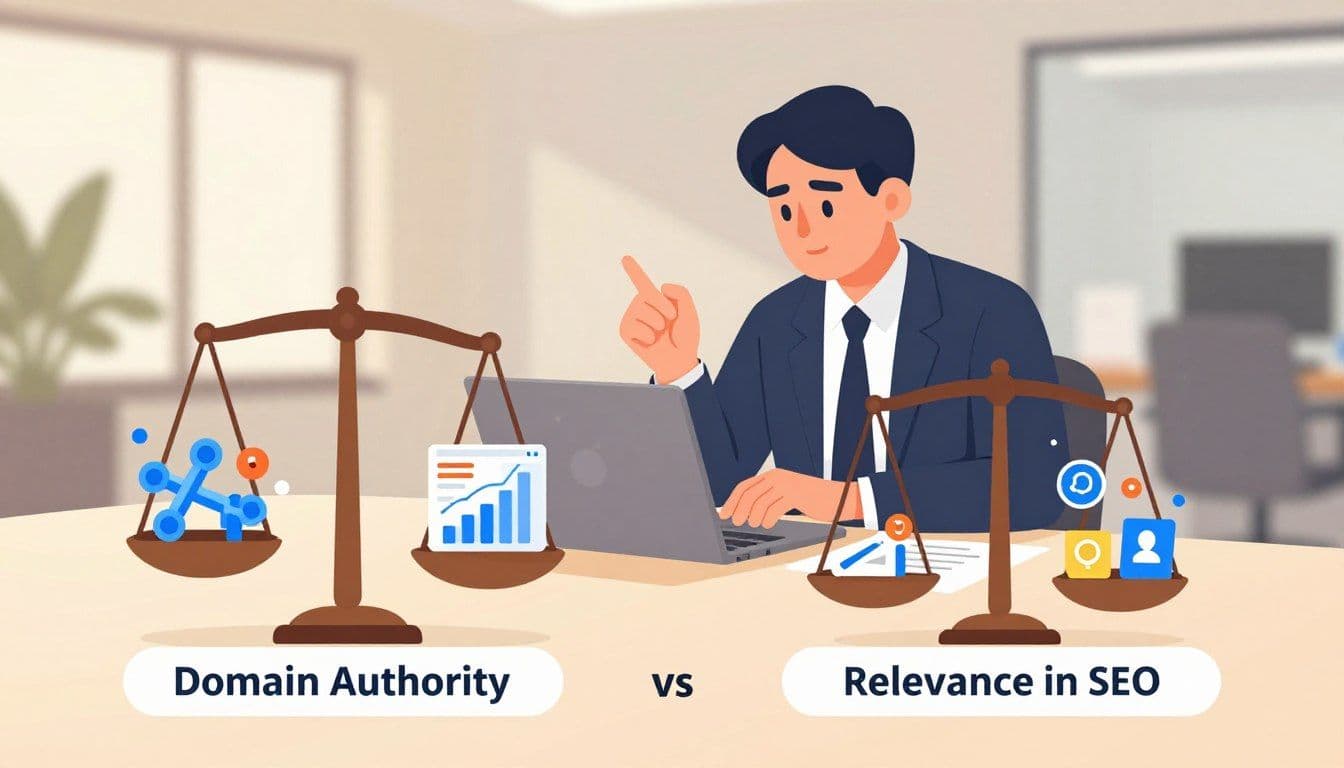
For a long time, link building was treated like a numbers game. Higher domain authority meant better links. Bigger sites meant stronger signals. If you could land a backlink from something with an impressive score, you were doing SEO “right.”
That logic worked when search engines were simpler and context mattered less than raw signals. It doesn’t hold up anymore.
What I see today is a quiet but important shift. Many teams still talk about authority, but when you look at what actually moves rankings and revenue pages, relevance does most of the work. Domain authority hasn’t disappeared. It’s just no longer the deciding factor people think it is.
The problem isn’t that DA is useless. It’s that it’s often used as a shortcut for judgment.
Domain authority was never the point
Domain authority is a comparative metric. It’s designed to estimate how a site might perform relative to others. It’s helpful for benchmarking. It’s useful for competitive analysis.
But it was never meant to be a proxy for ranking impact on its own.
Google doesn’t rank pages because a third-party score is high. It ranks pages because the signals around them make sense in context: what the page is about, who links to it, why they link, and how users respond after arriving.
When teams chase DA without asking why a link exists or who it’s for, they optimize for optics instead of outcomes.
That’s where link strategies start to drift.
Relevance is how search engines understand intent
Relevance is not an abstract SEO concept. It’s how search systems infer meaning.
When a page earns links from sites that operate in the same topical space, those links don’t just pass equity. They clarify context. They tell the algorithm, “this content belongs here.”
A lower-authority site that lives entirely within your niche often sends a stronger signal than a high-authority site that mentions you in passing. Not because it’s “better,” but because it reduces ambiguity.
Ambiguity is the enemy of rankings.
This is why pages with fewer backlinks sometimes outrank pages with many more. The links they have are doing clearer work.
Where DA-led link building quietly fails
The most common failure mode I see is not penalties or sudden drops. It’s underperformance.
Teams invest time and money securing links from impressive domains, then wonder why:
- rankings don’t improve meaningfully
- revenue pages stall
- traffic increases but conversions don’t
Nothing is “wrong” enough to trigger alarm bells. But nothing improves enough to justify the effort either.
This happens because relevance wasn’t doing any of the lifting.
A generic link from a powerful site can increase crawl frequency or overall authority signals. But it doesn’t necessarily help a page rank for specific, high-intent queries. Especially in competitive niches, context matters more than reach.
Relevance isn’t anti-authority. It’s selective authority.
This isn’t an argument for ignoring strong domains. It’s an argument for being more deliberate.
The most effective link profiles I’ve worked with tend to have a pattern:
- a small number of high-authority links that establish baseline trust
- a larger number of tightly relevant links that reinforce topical focus
That combination looks natural to search engines because it mirrors how real citations work. Broad credibility plus specialist endorsement.
Problems arise when teams try to replace the second group with more of the first.
How relevance shows up in performance, not theory
When links are contextually aligned, you tend to see changes that matter:
- specific keyword rankings improve, not just impressions
- referral traffic behaves differently
- engagement metrics stabilise
Visitors arriving from relevant sources already understand the problem space. They spend more time. They click deeper. They convert at higher rates.
Those downstream signals reinforce the initial link signal. The system becomes self-supporting.
This is why relevance-first link building compounds better over time.
Link acquisition as a positioning exercise
The best way to think about link building now isn’t outreach volume or DA thresholds. It’s positioning.
Every link answers a quiet question for search engines: where does this site belong?
If your backlinks come from everywhere and nowhere at once, the answer is fuzzy. If they cluster around a clear topical neighborhood, the answer sharpens.
This is especially important for sites that monetise content. Ambiguous positioning leads to traffic that doesn’t buy, clicks that don’t stick, and rankings that fluctuate.
Relevance reduces volatility.
What effective relevance-led strategies look like in practice
Relevance-led link building doesn’t require exotic tactics. It requires restraint.
It usually shows up as:
- content designed to solve niche-specific problems deeply
- relationships with publishers who serve the same audience
- links that make sense editorially, not just strategically
The best links often come from places where you didn’t have to explain why the link belonged there. The context already existed.
When teams have to “sell” a link hard, it’s often because relevance is missing.
Monitoring links through a relevance lens
Auditing backlinks purely through authority metrics misses the point.
A more useful question is:
- Does this link clarify what our site is about?
- Does it reinforce the audience we want?
- Would this citation make sense to a human reader?
Links that fail those tests might not be harmful, but they’re rarely helpful.
Over time, profiles dominated by loosely relevant links tend to feel noisy rather than focused.
Ethics, longevity, and why relevance protects you
Ethical link building isn’t just about avoiding penalties. It’s about building something that survives change.
Search engines update constantly. Metrics fluctuate. Scoring systems evolve. But relevance remains stable because it’s tied to meaning, not mechanics.
Links earned because they belong tend to age well. Links earned because they were easy tend to decay.
That distinction matters more now than ever, especially as automation makes low-effort link building cheaper and more tempting.
The real trade-off most teams miss
Chasing domain authority feels efficient. It simplifies decision-making. It gives teams something concrete to aim for.
Relevance takes more thought. It requires understanding your audience, your niche, and your long-term positioning.
But the payoff is different.
DA-first strategies often optimize for appearance. Relevance-first strategies optimize for performance.
Only one of those compounds.
Final thought
Domain authority still has a role. But it’s no longer the north star.
The sites that win consistently aren’t the ones with the biggest numbers. They’re the ones whose link profiles tell a clear story about who they serve and why they matter.
Relevance does that work quietly, but relentlessly.
And in modern link acquisition, quiet leverage beats loud metrics every time.