
19 Essential Tools for Answer Engine Optimization: Why They're Indispensable
Answer engine optimization requires a precise toolkit that addresses everything from schema markup to crawler verification. This guide examines 19 essential platforms and services, featuring insights from industry experts who rely on these solutions daily. Each tool tackles a specific challenge—whether it's securing attributions, mapping user intent, or measuring cross-platform visibility—to help websites earn prominent placement in AI-generated responses.

 VB
VB JB
JB MB
MB SK
SK CG
CG NS
NS MF
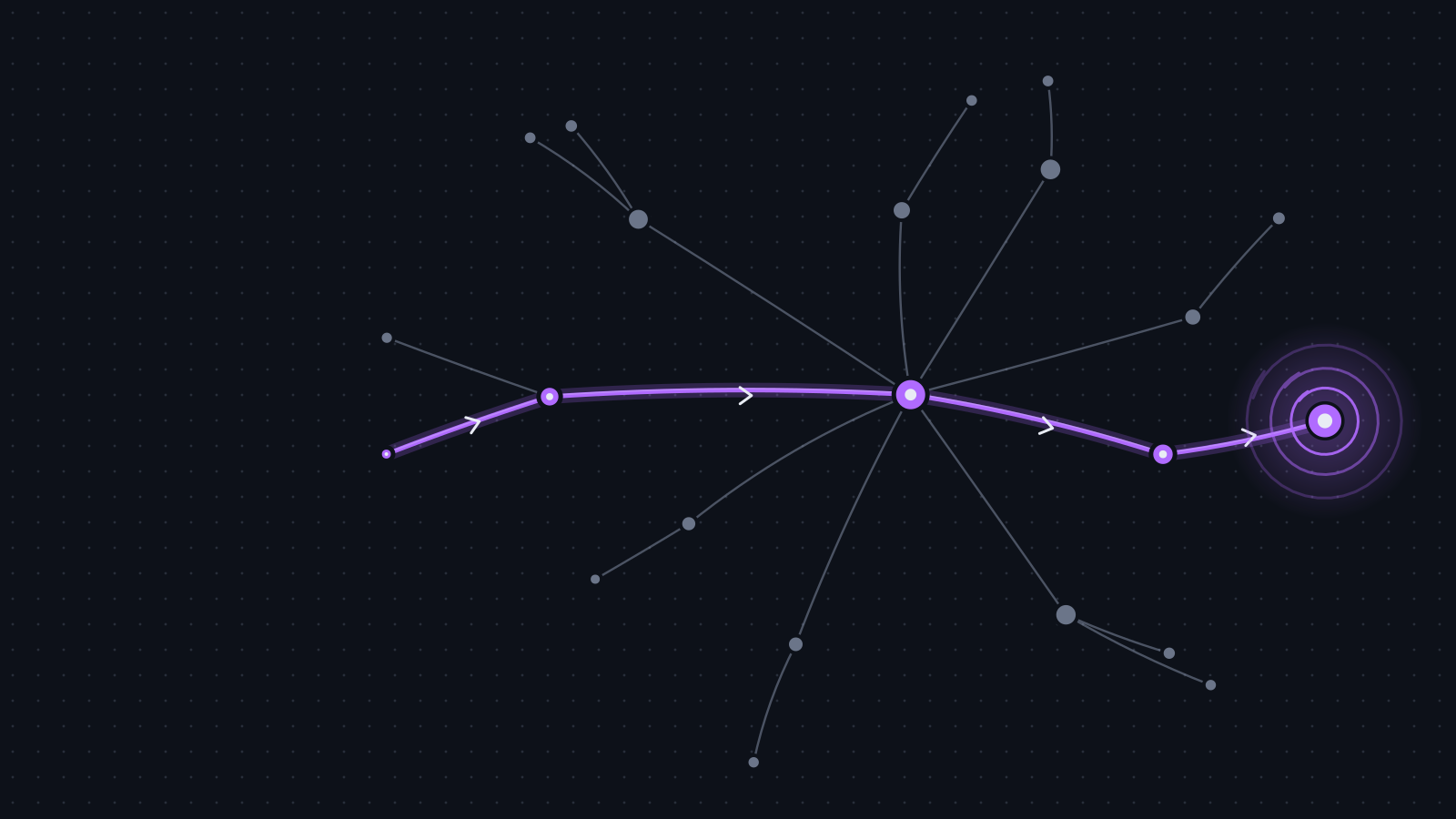
MF 19 nodes / Chris Raulf / Vikrant Bhalodia / Jock Breitwieser / Marc Bishop / Sahil Kakkar / Callum Gracie / Nassira Sennoune / Mike Fisher / Albert Richer / Ivan Vislavskiy / Arpit Jain / Brian Hansen / Derek Iwasiuk / Fahad Khan / Chirag Kulkarni / Ace Zhuo / Varun Gowda / Constantin Daniel / Çağdaş Topal
Featured.com Secures Trusted Attributions
Chris RaulfInternational AI and SEO Expert | Founder & Chief Visionary Officer / Boulder SEO Marketing
Featured.com is the single most valuable tool in my AEO workflow, and it's not close. Most people wouldn't even categorize it as an SEO tool, which is part of why it's underused.
Here's why it's indispensable specifically for answer engine optimization: AEO isn't about optimizing pages anymore, it's about becoming a source AI systems trust enough to cite. Featured.com is the fastest, most reliable mechanism I've found for building that third-party verification. When a journalist selects my response and publishes it on a high-authority site with proper attribution, that's not a backlink in the traditional SEO sense. It's a credibility signal that ChatGPT, Perplexity, and Google's AI Overview can cross-reference.
Compared to other options in the market, traditional SEO tools like SE Ranking or Ahrefs are excellent for keyword research, rank tracking, and competitive analysis, and I still use SE Ranking daily. But those tools optimize for a world where ranking equals visibility. Featured.com optimizes for the world we're actually in now, where being cited matters more than being ranked.
The concrete result: 24 publications over 18 months on domain authority 70+ sites, and I now get cited in Google's AI Overview and ChatGPT responses when people ask about AI SEO expertise specifically. No keyword tool gets you that outcome, because keyword tools optimize your content, not your verifiable authority as a source.
That's the distinction that makes it indispensable. Everything else in my stack helps me create better content. Featured.com is what makes AI systems trust that content enough to cite it.
ChatGPT Speeds Answer Refinement
Vikrant BhalodiaHead of Marketing & People Ops / WeblineIndia
If I had to pick just one, I'd go with ChatGPT. Not just for drafting content, but for testing how questions are interpreted, identifying gaps in existing pages, and refining answers so they match the way people actually ask questions in AI search.
What makes it indispensable for me is the speed of iteration. I can compare different content structures, validate whether an answer is clear enough, and uncover follow up questions in minutes. I still cross check performance with analytics and search data, but ChatGPT has become the fastest way to improve content for both traditional search and AI driven answer engines.
Semrush Pinpoints Missing Mentions
Jock BreitwieserDigital Marketing Strategist / SocialSellinator
Every SEO platform now promises the same thing: better AI visibility. The trap is treating that as a content problem, write more, publish more, when it's usually a measurement problem first. You can't fix your presence in AI answers until you can actually see where you're absent.
That's why Semrush's AI Visibility Toolkit has become the most valuable tool in my AEO workflow. Traditional tools, rank trackers, keyword suites, even Search Console, tell you how your pages perform in blue links. None of them tell you whether ChatGPT, Perplexity, or Google's AI Overviews actually mention you when someone asks a buying question. That blind spot is the whole game in answer engine optimization, and it's the gap this tool closes.
The feature I lean on most is Prompt Research. It works like keyword research for the AI era: you enter a topic and see the real prompts people are asking AI engines, which brands get named in the answers, and where you're missing entirely. Reviewing a client's data, we found a consistent pattern, they held solid Google rankings for their core topics, but were almost never cited in the AI answers to the specific, comparison-style questions buyers were actually asking. Competitors were owning those answers instead.
So instead of chasing more traffic, we targeted the prompts where we were invisible. We restructured pages to answer those exact questions directly, added the comparison framing the AI engines were pulling from, and tracked share of voice week over week in the Brand Performance report. Over about two months, the client's mention rate on those target prompts climbed from roughly 15% to just under half, without publishing a single new article.
That's why I find it hard to replace. Most tools tell me where I rank. This one tells me where I'm not even in the conversation and in AEO, that's the more expensive thing not to know.
Google Trends Flags Emerging Demand
Marc BishopDirector / Wytlabs
The single most valuable tool in answer engine optimization is Google Trends. Its importance comes from revealing demand shifts before standard SEO datasets fully update. That timing matters when audiences change language around products, problems, and comparisons. We find it indispensable because early pattern recognition creates a measurable content advantage.
Google Trends also helps frame answers around rising topics with geographic precision. That makes messaging more relevant, especially for seasonal or fast-moving categories. Many market tools excel at depth, yet they often lag emerging interest signals. Trends remains uniquely useful because it surfaces directional movement before competitors react.
Reddit Uncovers Genuine User Intent
Sahil KakkarCEO / Founder / RankWatch
The single tool that has mattered most in our answer engine optimization workflow is Reddit. It is not a polished SEO platform and that is exactly why we find it so useful. Answer engines are getting better at recognizing language that feels real and based on experience. Reddit gives us the natural words people use when they are confused, doubtful, or comparing different options.
We rely on it because most tools show demand after it becomes organized, while Reddit reveals intent much earlier. We can notice common concerns, hidden questions, and the real reason behind a search. Our advice is to study thread titles and the replies that create the most discussion. We then create content that answers the real concern instead of only matching the exact search words.
Claude Organizes Evidence for Credibility
Callum GracieFounder / Otto Media
The single most valuable tool in my answer engine optimisation workflow is Claude. Not because it magically tells you how to get cited, but because it is very good at turning messy expertise, search data, customer questions and brand context into something structured enough for a human strategist to judge.
For AEO, the hard part is not just finding keywords. It is making the brand easier for answer engines to understand, trust and cite. Claude helps me map what a page is trying to prove, what questions it answers, what evidence is missing, where the structure is weak and whether the content sounds like a useful source or just another generic marketing page.
I find it more indispensable than most dedicated AEO tools because trackers can show whether you are visible, but they do not fix the reason you are not being cited. Claude helps with the thinking layer: the definitions, comparisons, FAQs, expert framing, sourceable claims and clean explanations that make content more extractable.
I still would not let any AI tool make the final call. The workflow only works when a human checks accuracy, proof, brand fit and whether the page deserves to be cited in the first place.
Prompt Panel Verifies Monthly Progress
Nassira SennouneSEO Consultant / Originn Properties
Mine is embarrassingly low-tech: a fixed prompt panel plus Google Search Console, run together every month. The panel is a list of real buyer prompts, the questions our clients actually ask before a purchase: questions about buying a villa here, and about how the process works for a foreign buyer. Neighborhood comparisons are on the list too. I keep the list stable on purpose. Every month I run each prompt through ChatGPT and Perplexity and log which sources get cited for each answer, us or someone else. That log, boring as it is, is the truth about our AI visibility, and watching it month over month shows movement no dashboard shows me.
Search Console is the other half, and it is what makes the panel more than a scoreboard. When I rewrite a page to answer one of those prompts properly, I watch in GSC whether it starts gaining impressions on question-style queries. If the impressions move, the rewrite is working in search and usually starts appearing in the LLM citations some time later. If nothing moves anywhere, the page did not get better, whatever I told myself while editing it. For an in-house team of one on a single site, this loop beats any subscription tool I have tried, because it ties AI citations directly to specific pages I reworked.
AIOSEO Streamlines Rich Schema Setup
Mike FisherSEO Analyst / Dumpster Rental Systems
AIOSEO plugin for WordPress offers a structured data tool that made implementation much easier. Not only does it offer templates for a wide range of common schema types, but it allows you to create custom templates, and has an AI-powered feature that generates structured data based on page content. In my experience, AIOSEO outperformed several other plugins I tested, both in overall performance and range of features.
Server Logs Confirm Crawler Behavior

Albert RicherFounder & Editor / WhatAreTheBest.com comparison data
Raw server log analysis, hands down. I use AWS Athena to query my CDN logs, and it is indispensable for one simple reason. Answer engines have no Search Console. There is no dashboard from OpenAI or Perplexity telling you whether their systems are reading your site. The only ground truth is your own logs.
That visibility changed my whole strategy. On my software review platform, I can watch every AI crawler in real time. Referral traffic from Perplexity grew roughly 10x over two months. ChatGPT sends a few hundred user-triggered fetches a week, which means real people are asking it questions and it is pulling my pages to answer them. Amazon's crawler alone hits me 10,000 to 14,000 times per week feeding its AI systems.
Here is why that beats every third-party AEO tool on the market. Those tools tell you whether you appear in AI answers by sampling prompts, which is guesswork. My logs tell me which specific URLs the AI systems fetch, how often, and what they skip entirely. When a page never gets touched by AI crawlers, I know it has a structure or accessibility problem before I waste time optimizing the copy.
Most people treat AEO like a content exercise. It is a distribution exercise, and the logs are the only honest scoreboard.
Brand Radar Shows Cross-Engine Presence

Ahrefs Brand Radar is the tool I stick with for answer engine optimization because it shows real visibility instead of leaving things to guesswork. A lot of other tools are still built around classic SEO or give only partial views of AI answers, but this one keeps things consistent and shows exactly where a brand is showing up across answer engines. That makes it way easier to move fast and rely on real exposure data instead of assumptions or manual checks.
SeoSets Unifies Daily SEO Operations

Arpit JainOwner / SEO Sets
I'll be honest since anything else will seem contrived. SeoSets is the only tool I use most often because it is something I created after facing the same problems over and over again in more than 12 years of experience in SEO, automation, and software development. Over the years, I used some great SEO tools, and I have to say that some of them are really great at what they are supposed to do. My problem did not lie with these tools themselves; rather, my process was flawed. Every morning would start with opening various browser tabs, dashboards, Excel spreadsheets, and project notes.
Why is it always available? The reason why it is there is obvious. It helps to keep everything in connection. I can browse through technical audits, analyze the SEO reports, follow up on projects, and make use of additional web tools that go with my work without switching between products. Answer engine optimization cannot be done once and forever. It involves an endless process of identifying problems, prioritizing tasks, assigning actions, and verifying the results. Reports in connection with my work reduce my efforts since I do not have to spend time on figuring out where things stand next.
It does not imply that once there is one, everything else is obsolete. I still use Google Search Console for the information which I cannot get from any other third-party tool. Each of these tools - analytics, artificial intelligence, and search engines - gives an insight into a part of the puzzle. Relying on one software for all the answers is often wrong. To me, the most useful software is not the one with more features but the one with fewer hassles.
It is recommended to pick a software solution that will be actually used on a daily basis rather than the one that wins all comparison reviews. There have been quite a number of expensive tools purchased and seen being demonstrated in all their glory, which have never been part of my daily tasks. The benefits of additional functions are pointless unless they are applied regularly. A solution that will help you avoid opening five tabs just because of starting your work process.
Frase Builds Complete Answer Frameworks

Brian HansenPresident / Rocket Pilots
I would choose Frase because it shortens the distance between research and answer construction in a way that feels practical, not inflated. The value is in seeing how recurring questions cluster, how competing pages respond, and where the explanation usually breaks down. That makes it easier to build pages that feel complete from the first read.
Frase is indispensable because it supports a more conversational logic, which matters as answer engines reward content that resolves uncertainty instead of just introducing a topic. Many tools help collect keywords or audit pages, but Frase is especially good at turning messy search behavior into organized response frameworks. That helps content become clearer, tighter, and more aligned with real user expectations.
Google Search Console Guides Prudent Decisions

Derek IwasiukCo owner, Director of marketing / Searchtides
I have been working for more than 20 years in search marketing, and one thing I have learned is that there is nothing like experience. It is the tools that allow me to make good decisions and formulate better queries that are important. Google Search Console is one such tool that I use in my work with AEO and SEO in SearchTides.
I have tried out several different tools in the past, and while many of them seemed great, they didn't offer too much other than additional reports. Google Search Console still serves a purpose because it enables one to detect visibility shifts, search trends, technical problems, and gaps in their content.
In light of the fact that my research for AEO in the area of LLM marketing research involves new requirements, I need to think not only in terms of classic ranking methods. It becomes essential for me to see how brands are presented in AI responses, how data is processed and analyzed, and what gaps may be found in the process.
The problem that I see is how much people are using dashboards and how little judgment is being applied. The tool can display statistics, but it cannot provide reasoning as to why things are happening or what course of action should be taken. That is something gained through experience in the industry.
It is recommended to select software according to the tasks solved by that software and not according to the amount of functionality available. The newest platform may not be the most functional one. It is crucial to know how to work with the tool rather than possess it.
Profound Audits Sources at Prompt Scale

Fahad KhanDigital Marketing Manager / Ubuy Qatar
As an AI Search Strategist with 7 years of experience, one of the key weapons in my armory is Profound. I call it that because of the fact that it cites the source at prompt level, giving the source of each AI citation right down to the exact line of code from which it was generated. Legacy SEO suites are bolting AI-visibility onto older architecture; Profound was purpose-built for this.
That is because of the scale; in Profound's analysis of 10,000 prompts, ChatGPT comes up with a unique retrieval query 91% of the time when it rarely uses the same technique. That is the reason why checking the prompt one time is irrelevant, and using samples in large amounts is the entire methodological approach.
NotebookLM Validates Sitewide Knowledge Consistency

Chirag KulkarniFounder & CEO / Taco
The most valuable tool in our answer engine optimization workflow is NotebookLM. What makes it different is that it helps us pressure test whether a body of content can support trustworthy answers at scale. We load category pages, editorial pieces, support content, and public-facing documentation. We evaluate where the narrative is coherent and where the knowledge graph breaks down.
We find it indispensable because answer engines reward internal consistency more than most teams realize. A site can have strong traffic pages but still fail as a reliable source if claims, terminology, or structure conflict across assets. We use NotebookLM to expose those gaps quickly. Other tools help with discovery and monitoring, while this helps us judge if a brand builds a source machines can trust.
Perplexity Reveals Why Sites Win

Ace ZhuoFounder / Rankaisearch
I'd say Perplexity is the tool I rely on most. I use it to figure out how AI systems actually choose their sources. I'll search for the same queries my clients are trying to rank for and look at which sources get cited and why. It gives me insight into how these systems make decisions.
Most SEO tools weren't designed for this. They'll show you Google rankings, but they can't tell you why ChatGPT picked one source over another. Perplexity displays its citations as it searches, which lets me spot patterns. What I've noticed is that clear structure, authoritative tone, and direct answers consistently get chosen.
The takeaway? AI systems favor clarity over SEO gimmicks. I see this confirmed every time I run searches through Perplexity.
AlsoAsked Maps Natural Question Paths

Varun GowdaSEO Executive / The Super30
One tool that has become indispensable in answer engine optimisation is AlsoAsked. While many platforms focus on keywords and rankings, this tool stands out by mapping real user questions and showing how they branch into related queries. That structure is critical when optimising for answer engines like ChatGPT, Perplexity, and Google's AI results, where context and intent matter more than isolated keywords.
What makes it particularly valuable is its ability to reveal how people naturally explore a topic. Instead of guessing what to include in a page, it becomes clear which primary questions to answer, what follow ups to cover, and how to structure content in a way that mirrors real user thinking. This directly improves the chances of content being selected, summarised, or cited by AI systems.
The strategy built around this is simple but effective. Each piece of content is designed as a "question cluster". A core query is identified, followed by supporting sub-questions that are answered clearly using concise, structured sections. Formatting plays a key role using direct answers, short paragraphs, bullet points, and definitions that are easy for AI models to extract.
Compared to traditional SEO tools, which often prioritise volume and competition, this approach prioritises clarity, completeness, and relevance. It shifts the focus from ranking for a term to becoming the best possible answer source.
The key advantage is that it aligns content with how answer engines interpret and deliver information. As a result, visibility is not just about appearing in search results, but about being included within the answers themselves.
BrandGEO Measures Visibility across Platforms

Constantin DanielFounder / BrandGEO
The single most valuable thing in our AEO workflow isn't a specific tool feature, it's testing across every major AI engine independently, rather than just one. We built BrandGEO around this after seeing how differently ChatGPT, Gemini, Claude, and Perplexity answer the identical question. In our own research, we've found categories where all engines converge on the same recommendation, and others (a recent city-level study found a case with zero cross-engine consensus) where every engine gives a completely different answer. Any tool that only checks one engine, usually ChatGPT, since it's the most familiar, will systematically misjudge a brand's real AI visibility. That's the gap BrandGEO was built to close, and it's why single-engine checking tools feel incomplete to us now.
Constantin Daniel
Founder, BrandGEO, getbrandgeo.com
DataForSEO Powers Affordable, Actionable Intelligence

Çağdaş TopalFounder / ToolNavigate
Honestly, it's DataForSEO. I use it for two things. First is keyword intelligence: instead of guessing what to write next, I check real search volume and competition data. Second is backlink gap analysis. It shows me exactly which sites link to competitors but not to us, so outreach goes to real prospects instead of a cold list pulled from nowhere. It costs about a penny or two per query, so I run it daily without ever thinking about the bill. For a bootstrapped, AI-assisted operation like mine, that kind of cheap, constant data access matters more than people realize.