
Link Building Advice Assumes You Have Authority. Here Is What to Do When You Have None.


Most link building advice has a hidden prerequisite: it quietly assumes you already have something. An audience to promote to, a brand people recognize, a domain with enough history that outreach emails get opened. Strip that away, as anyone launching a genuinely new website must, and much of the standard playbook stops making sense.
I know because I did exactly that this year. In early 2026, I launched a new domain from absolute zero: no backlinks, no brand searches, no history. And I chose, of all places, to do it in the SEO niche itself; the one vertical where every single competitor is, by definition, a professional at ranking.
There is no soft opening in this market: the sites above you were built by people who do this for a living, often with teams and decade-old domains. Six months later, the site ranks for more than 1,000 keywords, went from near-zero to over 1,000 daily impressions in roughly three months, and sits at a Domain Rating of 9.
Those are not numbers that will impress anyone at an SEO conference, and that is precisely why I want to share them. This is what the early curve actually looks like when you build links the slow, legitimate way, and I would argue the shape of that curve matters more than its size.
The part nobody shows you: Impressions arrive long before clicks
Here is my Search Console reality, unfiltered: roughly 64,000 impressions in six months, and only a few dozen clicks, with an average position around 52. A new domain does not fail quietly, as it succeeds invisibly.
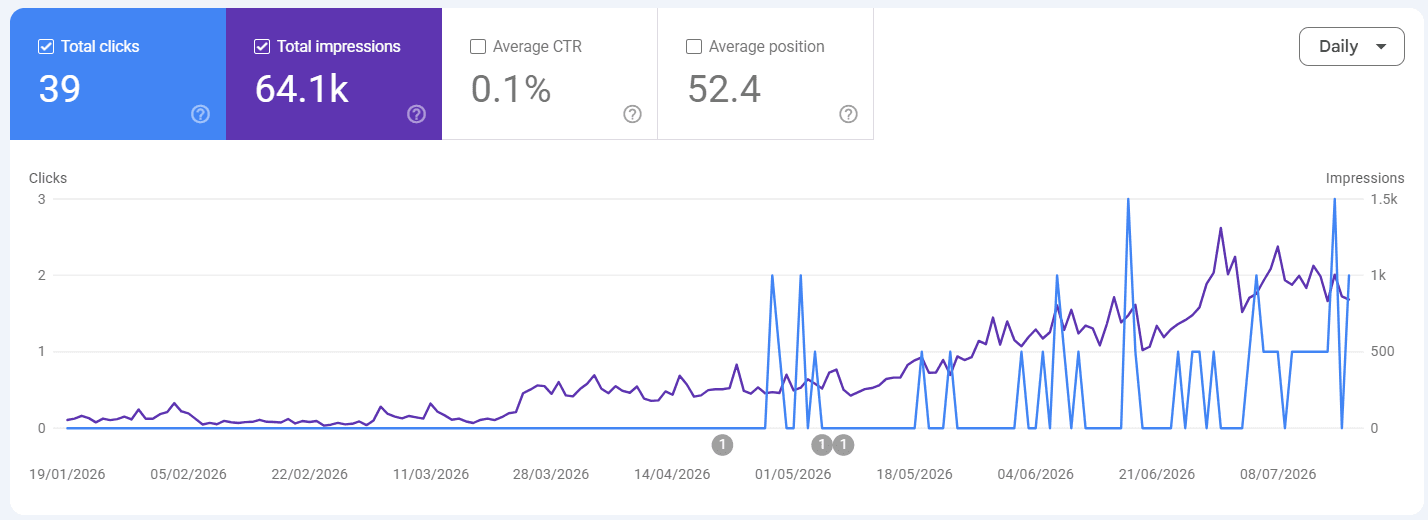
Google begins testing your pages on page five, then page four, long before any human sees them. My site currently appears for a high-volume term in my niche with over 5,700 impressions at an average position of 75. That is not a failure; that is a queue.
This matters for link acquisition because it reframes what links are for at this stage. You are not building links to capture traffic yet. You are building links to give Google corroboration; independent evidence that a site with no history deserves to keep moving up that queue. Once you accept that, your priorities change completely.
What I deliberately did not do
I sent no mass outreach. When your domain is new, template outreach is a numbers game you lose twice: your emails get ignored because nobody knows you, and the few links you would land come from sites doing reciprocal favors, which is exactly the neighborhood a new domain should avoid. I also bought nothing. A fresh site with three months of history and a suspiciously convenient link profile is asking for scrutiny it cannot afford.
What actually acquired links (and authority)
Becoming a citable source before asking for anything. The single most efficient channel for a new domain is expert commentary - platforms where publishers actively look for quotable specialists, along with genuine participation in communities where my audience already asks questions. Every placement produces an editorial mention from a page that real people read, with my name and site attached. These are links no algorithm update has ever punished, because they exist for the reason links were invented.
Publishing depth on my own domain first. Guides, checklists, tools people can actually use. Not because "great content attracts links" on its own - for an unknown site, it mostly does not - but mainly because every mention I earned elsewhere pointed back to something worth landing on. Link acquisition without a linkable destination is a referral to an empty room.
Spreading surface area across formats. A YouTube channel, contributed articles, community answers. Multi-format presence does something subtle for a new brand: it creates navigational searches. The first keyword my site ranked #1 for was my own brand name, and branded search is the trust signal that makes every other ranking easier.
Treating every link as an editorial decision, not a transaction. My DR is currently 9. A veteran link builder might scoff. But those points came from perhaps a handful of genuinely earned, relevant mentions, and Search Console shows Google responding: the impression curve bent upward within weeks of the first real editorial placements, from a flat line to four digits per day.
The honest limits and the turn
Average position 52 means most of my rankings are still promises, not traffic. Clicks lag impressions by months on a new domain, and no link-building tactic shortcuts that; the sites that try are the ones that vanish in the next core update. But this is also where the story bends. Week by week, those queued positions have been climbing, and the clicks have started to follow: roughly half of all the clicks this site has ever received arrived in the last thirty days alone.
That is what the compounding phase looks like from the inside - flat, then slow, then suddenly not. In the most competitive vertical on the internet, reaching that inflection point in under six months is, I would argue, the real result. What links do is compress the waiting: every legitimate editorial mention is an argument that the queue should move faster.
If you are starting from zero in 2026, ignore the advice written for sites that already have gravity. Become quotable, publish something worth linking to, show up where your audience already is, and read your Search Console impressions - not your traffic - as the early scoreboard. Authority is built in exactly this unglamorous order. The traffic is simply what it looks like later.