
The 2026 Link Acquisition Playbook: Earning Citations from ChatGPT, Perplexity and Google AI


I run an AEO company, which means I spend most of my week watching how ChatGPT, Claude, and Perplexity decide which brands to name. So I'll say this up front: most link-building advice you'll read this year is going to feel slightly off, and it's worth understanding why before you spend another quarter chasing referring domains.
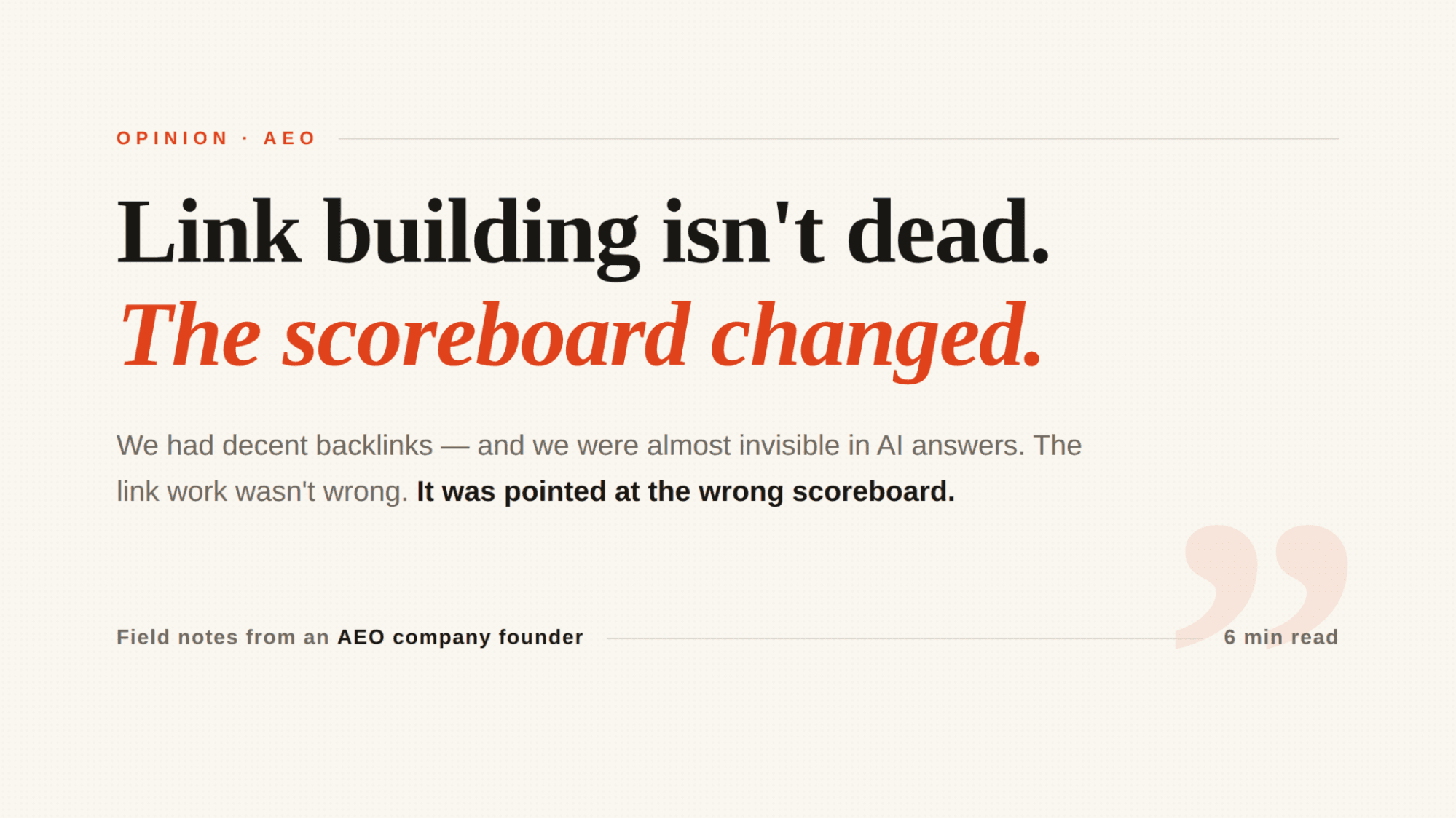
Here's what happened to us. Before we launched, I ran our own tool on our own company — the same thing we sell to customers — to see how AI engines talked about us. We were almost invisible. Ask ChatGPT for the best tools in our category and our name basically never showed up. And we had decent backlinks. That was the moment it clicked: the link work wasn't wrong, it was pointed at the wrong scoreboard.
Because a lot of buyers just don't look at ten blue links anymore. They type a question into an AI assistant, read one answer, and move on. If that answer names two or three companies and you're not one of them, it doesn't matter how well your page ranks on Google. The buyer never got there.
None of this means links are dead. They matter as much as ever. But the reason they matter has quietly changed, and once you see it, your whole approach to link acquisition and content shifts. Here's how I think about it now.
The old scoreboard is measuring the wrong game
Classic search hands the decision to the user: it shows the options, the person picks. AI search flips that. The model builds the shortlist first, then shows a few sources to back it up. When an engine says "the leading options are A, B, and C," it grabbed those names from specific pages it trusts in that moment, and most people never scroll past the shortlist to check.
So a backlink's value isn't just the authority it passes you anymore. It's whether the page linking to you is one the AI actually reads and repeats when it writes an answer. A link from a big-name site no engine ever pulls from does less for you than a Reddit comment the model quotes word for word. Same effort, completely different payoff. That's the part Domain Authority can't see.
Start by finding where your answers already come from
Before you go earn a single link, do some homework. Write down the questions your buyers actually ask on the way to buying — not keywords, real questions. "What's the best tool for X." "Alternatives to [competitor]." "Is this even worth it for a small team." You probably know 20 or 30 of these off the top of your head.
Now go ask the AI engines those questions and watch what happens. Are you mentioned? Who else is? And most importantly, which sources does the engine cite? Do it on ChatGPT, Perplexity, and Google's AI Overviews, because they don't trust the same places — you'll often see the same brand pulled from different sites on each.
Give it an afternoon and the pattern gets obvious. A handful of source types keep showing up: Reddit and niche forums, review sites like G2 or Capterra, a few trade publications, and clean pages on brands' own domains. That's your target list. You're not building links at random now, you're reverse-engineering the exact pages the machines already trust for your category — a much shorter, much more useful list than "sites with DA over 50."
Earn your way onto those specific sources
Once you know where the answers come from, the work gets targeted. Different sources need different moves, though, so don't treat them the same.
Reddit and forums reward showing up like a person, not a marketer. Find the threads that already get cited for your questions and actually answer them, the way a practitioner would, with something specific. One genuinely useful comment on a thread the AI quotes can beat a month of outreach. Just keep it mostly non-promotional — the second you turn every comment into a pitch, the mods and the algorithm both bury you.
Review sites are almost free wins. If AI leans on G2 (or whatever the equivalent is in your space) when it recommends tools like yours, a complete, current profile with real reviews is the floor, not a nice-to-have. Brands with profiles get named. Brands without them don't.
Editorial mentions are where old-school link building and this new world overlap the most. A quote in a trade publication or a contributed piece gets you a link and a citation in one shot. The fastest way in is the source-request networks journalists use: you answer a reporter's question with something sharp and specific, and you pick up mentions the AI later recycles. I've watched a single good quote keep paying off for months.
And don't sleep on your own comparison pages. AI quotes "X vs Y" and "alternatives to Z" pages constantly, usually the honest ones that don't pretend you win every round. Write the fair version. It gets cited because it reads as fair.
If you only do one thing, publish your own data
This is the highest-leverage move I know, so I'll be blunt: go make original data. A number nobody else has published is the single most linkable, most citable thing you can put online right now. Two things stack here — writers cite data, so you earn natural links, and AI engines love concrete, sourced claims, so those links turn into repeated citations with your name on them.
You don't need a research team. Pick one sharp question in your category you can actually answer — look at a sample of companies, analyze a batch of public pages, survey your own users — and report it honestly, methodology and all. Narrow beats broad. One defensible number that's genuinely yours will out-travel ten more "ultimate guides," because it hands every writer in your space a reason to link to you and every AI engine a fact to credit to you specifically. When we did this in our own category, that one study moved our visibility more than anything we ever wrote about ourselves.
Write content the machines can actually lift
Your own content still matters, but the format that wins changed. AI extracts and quotes. It rewards a page that answers one question, early, in plain words, with a structure it can parse. A few things I'd change if I were auditing your content today:
Answer the question in the first line, not after 400 words of warm-up. Don't make the model dig for it.
Use claims a machine can pull. "Covers 11 engines in 9 languages" is quotable. "Comprehensive, best-in-class coverage" is filler nobody cites.
Keep your facts identical everywhere. AI cross-checks sources, and if your own pages disagree about what you do, it picks one — often the wrong one.
The shift is small, but it changes everything: stop trying to write the longest page on a topic and start trying to write the most quotable one.
Measure whether AI names you, not how many links you built
You can't manage what you don't look at, and a link count won't tell you whether Claude recommends you. So add a couple of numbers to whatever report you already run. Mention rate: across the questions you care about, how often does the AI name you at all? Citation rate: when it does, is it linking to your content, or to some third-party page describing you, maybe wrong?
Track those for a few weeks and your update stops sounding like "we built 40 links" and starts sounding like "we went from named in one of ten answers to one of three, and closed two spots where a competitor owned the answer." A founder or a CMO actually cares about the second sentence. The first one is just activity.
The mistakes I see most
The most common is chasing DA for its own sake. It still tracks with quality, but if the page never gets read by an engine, the score is beside the point. Sort your targets by "does AI cite this," not by a number.
The second is letting AI-driven interest hide inside "organic" or "direct" in analytics, so nobody sees it and nobody optimizes it. Give it its own line and it becomes something you can grow on purpose.
The third is scattered, inconsistent facts about your own brand, which quietly lets the AI describe you with the outdated version. And the last one is one-and-done PR: a single mention fades, but steady presence across a few trusted sources is exactly what makes an engine comfortable saying your name.
Where I'd start this week
If this is new, keep it simple. List twenty real questions your buyers ask. Run them through ChatGPT, Perplexity, and Google's AI Overviews and write down who gets named and what gets cited. Pick the two or three source types that keep coming up and plan one placement on each. Ship one small original data point. And write down your mention rate today, so you have something to compare against next month.
Link building isn't going anywhere. The links worth earning are just the ones AI reads and repeats, and the content worth writing is the content it can lift cleanly. Figure out which sources answer your category's questions right now, get onto them, publish something only you could publish, then watch whether the machines start saying your name. That's the whole game now.