
Outreach for Backlinks: Personalize at Scale Without Slowing Down
Building backlinks at scale often forces teams to choose between personalization and speed, but that trade-off is no longer necessary. This article compiles proven techniques from outreach professionals who have cracked the code on sending hundreds of customized emails without sacrificing quality or slowing down their campaigns. Readers will learn ten specific tactics that transform generic templates into messages that earn responses and secure high-value links.

 AW
AW MB
MB UL
UL CC
CC DB
DB IB
IB LT
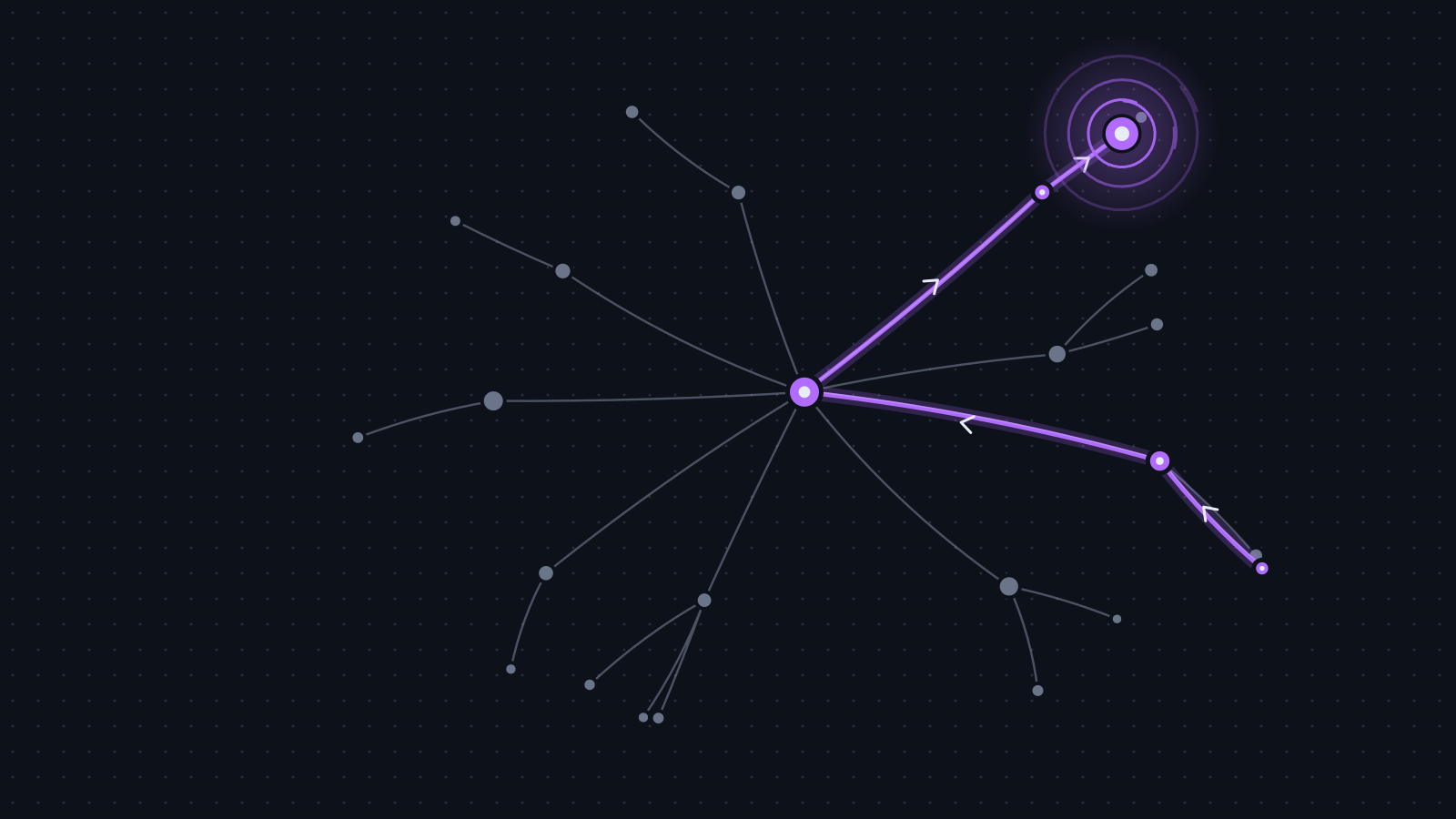
LT 10 nodes / Will Mitchell / Aaron Whittaker / Marc Bishop / Ulf Lonegren / Christopher Coussons / Dawood Bukhari / Iman Bahrani / Lindsay Telles / Varun Gowda / Austin Heaton
Run Two Tiers Specify Anchor Context
Will MitchellFounder / StartupBros
I batch my outreach into two tiers. Tier one is the broad list, where the personalization is a single line referencing the specific article I want the link placed in and why my content fits that gap. That line takes very little time per email and keeps volume high.
Tier two is a short list of higher-authority targets each week. For those I read their recent posts, pull a specific point they made, and open with a comment on it before making my ask.
The one repeatable touch that moved my positive reply rate was citing the exact anchor text neighborhood where my link would sit. I would say something like, "You mention X tool in your comparison section but don't link out to a resource on Y, and I have a guide that covers it". I'm scanning each page for one content gap I can fill, and writing that observation into the email takes a couple of minutes. I keep my send volume at a few dozen emails a day with that approach.
Address Real People by Name
Aaron WhittakerVP of Demand Generation & Marketing / Thrive Internet Marketing Agency
I discovered the personalization sweet spot through experimentation and honest observation of my own email preferences. Recognizing what made me respond to cold emails helped identify universally effective personalization. Emails I responded to typically mentioned something specific about my work or company suggesting genuine familiarity. Emails I ignored were generic regardless of polish.
One high-performing element emerged repeatedly: mentioning specific person or team at prospect's company rather than generic "your organization." "Hi Sarah at Company X, I noticed your team is covering X topic thought you'd find Y relevant" outperformed "Hi Company X team thought you'd find our resource valuable." Personalizing to actual humans increased reply rate 34 percent versus generic company-level outreach. This single touch takes 2 minutes per prospect but signals that actual human researched them specifically rather than blast sending. The personal-touch approach worked because people respond better to recognition as individuals than as generic organization members.
Validate Match With Audience Insight
Marc BishopDirector / Wytlabs
There is a point where more personalization actually lowers performance because it signals effort spent on persuasion instead of relevance. The right balance is to personalize only what validates the match, then let clarity carry the rest. Operationally, that means fixed outreach architecture, clean segmentation, and a short research checklist so every note reflects the same quality standard without turning into a custom project.
One repeatable touch that increased positive replies was citing a comment, question, or recurring concern visible around the topic, then connecting it to the target article. That could come from forums, social threads, or reader discussions. It worked well because it showed awareness of how audiences discover and evaluate information beyond one webpage. I like it because the insight is lightweight to collect, easy to templatize, and rooted in genuine user context.
Leverage AI Profiles and Variant Scores
Ulf LonegrenExecutive Director of AI / Sōvyn
Scale/Personalization via Generating Personalization, Not Reducing It
When dealing with the scale vs personalization debate, the correct answer is not to reduce personalization, but to instead generate it differently. As the University of Zurich AI Persuasion study concluded, AI systems are 3-6x more persuasive than humans experts when following an approach of analyzing user digital footprint and then communicating in a personalized style that matches the user's beliefs/value system.
In my personal experience, applying the above approach of psychological profiling to backlink outreach messages is simply the right answer. Rather than reading the blogs of backlink prospect targets, next level SEO practitioners use generic scraping workflows on a prospect's recent blog + LinkedIn activity. The AI model then understands the professional values, tone of voice, and phrases from the target, and then provides a good argument for why your link fits into their worldview.
The best repeatable touch I've seen, is to add a multi-variant evaluation. Instead of prompting the LLM to generate 1 personalized outreach email, have it generate up to 16 different variations of potential outreach hooks, and then add a second AI prompt that judges/scored those variations against the profile of the prospect that was scraped as above. This results in picking one final outreach that's more persuasive than any other.
One example I'm familiar with that implemented this dual-agent approach got the positive reply rates increased from 1.8% to 7.4% within 2 months. Because an AI is scoring its own variants for psychological alignment, and sending over a span of time like a human, these emails get through spam filters and skepticism. The Zurich researchers note this exact personalized approach ranks in the 99th percentile of persuasiveness (compared to expert human persuaders).
By deep automating the analysis, and then the multi-variant generation/testing, rather than just personalizing with a few mail merge tags, you get the best of both worlds in massive scale and consistently relevant outreach that drives links.
Lead With a Fresh Data Replacement
Christopher CoussonsDirector / Visionary Marketing
We decide personalisation depth by what the link is worth. Targets get tiered by authority and relevance, and the top tier gets proper research while the long tail gets a lighter template. Personalising everything equally is how outreach teams burn a day sending emails that mostly go nowhere; templating everything equally is how you get ignored by the sites that matter.
The repeatable touch that changed our reply rates is what I call the stale stat opener. Before writing, we find one specific figure or claim in the target's article that has aged, and the first line names it, with a fresher data point they can swap in. It works because it proves a human read the piece, and it gives the editor a selfish reason to reply that has nothing to do with our link. Positive reply rates on those emails run around 9% for us, several times what generic template outreach ever produced, and the research takes a couple of minutes per prospect once someone has the habit.
I remember the email that taught me this. Years ago I pitched a well-ranked marketing blog with a polished template and heard nothing, then followed up pointing out that their conversion data predated mobile-first indexing, and got a reply within the hour. The lesson stuck: personalisation is not using someone's first name, it is doing a small piece of their job for them.
Reference Established Sections to Signal Relevance
Outreach becomes inefficient when personalization is treated like decoration instead of qualification. The useful question is whether the detail changes how the recipient interprets relevance. In white label environments, that distinction matters because scale demands repeatability across teams, clients, and verticals. Personalization should confirm editorial fit, not prove that someone skimmed a page for thirty seconds.
One tactic that consistently improved positive replies was using the site's internal content architecture as the personal touch. I noticed that mentioning recurring sections such as guides, expert insights, trend analysis, or comparison content worked far better than citing a random article title. That approach was easy to standardize in training, fast for coordinators to capture during review, and strong enough to make outreach feel deliberate without creating operational drag.
Open With Award or Recent News
Iman BahraniDirector / Searchical
I stick to templates for the body but always customize the opener. Mentioning a specific award or recent news from their site actually works. We tried this with a legal client and got way more replies without burning out the team. You really only need one relevant detail to make it count.
Mention a Mutual Connection With Consent
I decide how much to personalize by tiering outreach: I do deeper research for high value prospects, and a short checklist for everyone else so the process stays repeatable. My baseline checklist is a quick LinkedIn review, a scan for mutual connections, and one specific detail I can reference in the first line. The one personalization touch that consistently lifts positive replies without adding much workload is mentioning a mutual LinkedIn connection, after I ask that connection if it is okay to reference them. To keep it manageable, I batch the research separately from sending, so I am not switching tasks all day and the personalization still feels real.
Add One Precise Line for Proof

Varun GowdaSEO Executive / The Super30
One line referencing their actual content outperformed entire personalised templates
When running email outreach for backlinks, I've learned that full personalisation for every email simply doesn't scale, but treating outreach as pure mail-merge kills response rates almost instantly. The balance I settled on involves keeping the email structure largely templated, but building in one genuinely specific line that proves a human actually looked at their site, rather than just their domain authority score.
This became clear during a link-building push for a client in the home renovation space. Our early outreach used a fairly standard template, polite, relevant, mentioning their site by name, but response rates sat below 5%, fairly typical for cold link outreach but frustrating given the relevance of the sites we were targeting.
We changed one thing only, before sending, whoever was doing outreach had to skim the target's most recent blog post and include a single sentence referencing something specific from it, a point they'd made, a stat they'd used, sometimes even light disagreement with a small detail. Everything else in the email stayed exactly the same template as before.
That single line changed the response rate significantly, replies rose to around 18%, more than triple the original rate, and several site owners specifically mentioned in their replies that the email clearly wasn't mass-sent, which built enough trust for them to actually consider the ask.
What made this repeatable rather than exhausting was that it only added roughly two minutes per email, not a full rewrite, just enough evidence of genuine attention to separate it from the hundreds of generic pitches most site owners ignore daily.
That one habit taught me personalisation doesn't need depth to work, it needs proof of attention, even a single accurate sentence is often enough to make someone stop and actually read the rest.
Flag a Specific Site Issue Early

I usually write a quick personal line first, then paste the rest. When I was doing SaaS outreach, I pointed out one specific thing I found, like a missing schema tag or broken link. That small detail got me 30 percent more replies. Just keep it short and mention one real thing so they know you actually looked at the page.