
Smart Link Reclamation in Link Building: What to Fix, Replace, or Let Go
Broken backlinks can quietly drain traffic, authority, and revenue. This guide shows what to repair, replace, or leave behind before valuable opportunities disappear. Insights from link-building experts explain how to prioritize recovery and earn stronger references.

 LB
LB JH
JH FK
FK AW
AW JB
JB JR
JR PS
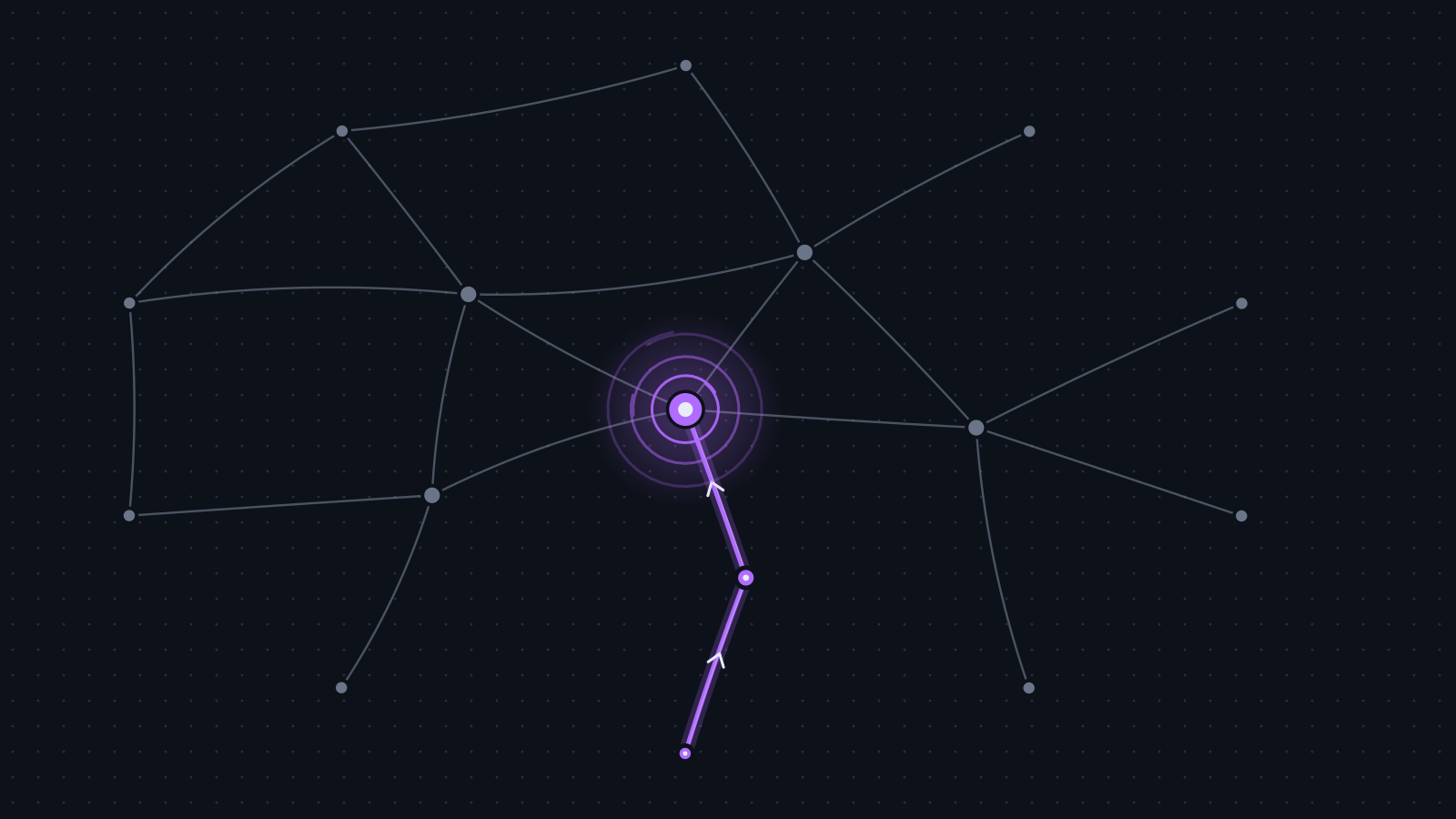
PS 25 nodes / Rick Elmore / Lilach Bullock / Jason Hennessey / Faizan Khan / Aaron Whittaker / Jock Breitwieser / Jase Rodley / Philip Stoelman / RHILLANE Ayoub / Marc Bishop / Eric Turney / Paul Eidner / Daniel Nyquist / Nassira Sennoune / Madeleine Beach / Vlad Ivanov / Will Yang / Mark Bietz / Christopher Coussons / Trevor Gage / Fahad Khan / Chirag Kulkarni / Richard Meadows / Ankita Pathak / Redha Alayesh
Audit Traffic Before Recovery
Rick ElmoreCEO / Simply Noted
My rule is simple. I only chase a lost link if the page that held it still gets traffic or still ranks. If the page is dead, the link was dead too, and emailing about it just burns goodwill with an editor I'll want later.
We lost a placement last year when a mid-size sales blog restructured their whole resource section. About forty of their pages 404'd, one of them ours. Instead of firing off a "hey your link is broken" note, I pulled their new site structure, found the article that had replaced the old one, and emailed the editor with a line about the topic they'd just started covering, plus an offer of original data from our outreach campaigns. Got placed on the new page inside two weeks, and it was stronger than what we lost because it sat closer to their money pages.
What saved effort was checking first, not asking first. Broken link on a page nobody visits is not worth a follow up sequence.
The other thing I'd say. Don't panic over a single drop. Look at whether the whole referring domain is decaying. If a site's traffic has been sliding for a year, replacing that link somewhere healthier beats reclaiming it.
Rick Elmore, Founder and CEO, Simply Noted
Refresh Content, Then Earn Coverage
Lilach BullockAI Implementation Consultant and Fractional CMO / Lilach Bullock
I chase a fix only if the link sits on a page I still control contact for, otherwise I move on fast. I tried reclamation outreach on six occasions over the past two years and recovered exactly one link, so I stopped treating it as a reliable channel. Now when a backlink disappears I put the effort into rewriting or refreshing the page that lost the link and earning a new placement elsewhere, rather than chasing the old one.
Align Alternatives With Buyer Intent
Link reclamation should begin with a counterfactual, what would change if the link never returned? I compare traffic, topical proximity, and destination-page resilience. If rankings, leads, and crawl discovery remain stable, urgency is manufactured. The exception is a link that acts as a trust bridge between a publication and a high-stakes decision page.
That filter stopped pursuit of a but abandoned university article. Its successor no longer existed, and its referral audience had vanished. We instead pursued a trade publication whose readers were evaluating the same service. The coverage generated inquiries and earned citations naturally. Performance held because the replacement matched buyer intent, not an authority score.
Validate Context Before Restoration
Faizan KhanPR and Content Marketing Specialist / Ubuy Indonesia
The main question when a valuable backlink is lost is whether its value is tied to the specific page or to the domain and its surrounding context. In case the latter happens, reclamation is needed. When the value lies in a particular page and its content or ranking, trying to get it back will be a waste of time.
For example, we managed to save some effort by reclaiming a backlink to a resource page (DA 60s) that was lost during a site restructure. Before requesting this link back, we checked whether the page existed or if it ranked for anything. The page no longer ranked, had almost 0 traffic, and was combined with another page. Thus, instead of trying to find a solution, we offered a resource on another page within this domain.
This placement required only half as many back-and-forth messages as a typical reclamation and was on a page receiving about 3 times the original peak traffic.
Conclusion: Check if the context is still valid before requesting the link back.
Defend Signals That Drive Revenue
Aaron WhittakerVP of Demand Generation & Marketing / Thrive Internet Marketing Agency
When I email anyone about lost links, the first thing I do is check whether that page delivered anything in terms of referrals or trust, because most of the time, reclamation involves trying to chase links that were never even doing anything in the first place. The two questions that inform your decision are: was that linking page indexed and delivering real authority and is the exact placement replaceable? If it was deindexed whereas the entire site went dark, I wouldn't waste a week emailing a webmaster who is already gone, instead I use my time to find a new placement.
For example, for a legal lead-gen client, we track our top referring pages by actual traffic and the contribution of ranking factors, not just by raw link count. When one of the links from the stronger referring pages dropped off during the redesign of the website, I could see that it was consistently feeding the page ranking for money terms. So that required a direct: "Hey, this dropped off in your migration" email. It came back in two days for us. The dozen directory links that dropped off the same month? I left them and invested my time in other placements instead, which is part of how this account increased organic keyword rankings up to 1,000%.
I keep it simple: reclaim links that move rankings, replace those that cannot move, and ignore the ones that were never doing anything.
Restore Live Mentions First
Jock BreitwieserDigital Marketing Strategist / SocialSellinator
Most people panic when a good link vanishes and immediately chase a replacement, which is usually the most expensive option. Before doing anything, I figure out why it disappeared, because that usually tells me whether to fix it, replace it, or move on.
If the page is still live but the link was dropped during an edit, that's the easy case. I'll send a quick, friendly email asking whether they can restore it. You already have the relationship and the page still exists, so recovering the link is usually far less work than earning a new one.
If the whole page is gone, there's nothing to fix. Then I look at how valuable that link actually was. If it came from a strong, relevant page, I'll consider finding a comparable replacement. If it wasn't particularly valuable, I'll move on rather than spend hours recreating something that isn't worth the effort.
One situation that saved me a lot of work was catching links that had disappeared during site redesigns. Instead of assuming they were gone permanently, I checked whether the original pages were still live and reached out to the site owners. Several links were restored with simple emails, which saved us from having to start new outreach campaigns for those placements.
My rule is simple: recover before you replace.
Prioritize Backlinks by Impact
Jase RodleyFounder & SEO Consultant / Dialed Labs LLC
The first thing I look at when a backlink disappears is how valuable it actually was and whether it's worth spending the time we will to get the link back. Even with "valuable" links, if the link doesn't make sense on the site anymore, I'd rather spend the time looking for other relevant linking we can do instead. The link needs to have been a major traffic draw or it should have linked to an extremely important page for us to invest in getting it back.
Every link you lose isn't worth chasing. You don't need to put in the same amount of time or attention and waste effort because even if a link was valuable earlier, things could have changed since then. So it's worth doing that analysis before you decide.
Reclaiming links shouldn't just become a task in the workflow.
Decide Within Forty-Eight Hours
Philip StoelmanFounder & CEO / Network Republic
I give myself 48 hours to make a call on any lost link, and I don't let it sit longer than that. Waiting too long usually means the opportunity to fix it quietly closes.
A good example of this happened with a logistics conference we sponsored. They had linked to our IT lifecycle services from their event recap page. Months later, they archived the whole page during a site redesign and the link went with it. I checked their new site structure first and found they'd kept a version of that recap under a different URL entirely.
Instead of asking for a brand new mention, I pointed the event coordinator straight to the archived page and asked if the link could carry over to the new one. My email was four sentences. I named the old URL, named the new page I'd found, and asked one direct question, something like "would it be possible to add our mention to the updated version instead." No long explanation, no history lesson about why the link mattered.
It took them one afternoon to make the update. Based on my years doing this, a short and specific ask outperforms a long and polite one almost every time.
Repair Redesign Losses Via Email

We check whether the page still exists first, if it is a 404 or redirect, we ask for a fix since that is usually a fast yes. If the page is gone for good, we look at whether the site itself still has authority worth another placement before spending time pitching a replacement. One case saved us real effort: a client link disappeared during a site redesign, and instead of chasing a new placement we asked the publisher to add it back into the new page, which took one email instead of a fresh pitch cycle.
Rhillane Ayoub, Founder and CEO, Rhillane Marketing Digital
Favor Pathway Value Over Prestige

Marc BishopDirector / Wytlabs
Authority is often overvalued after a link disappears. A placement can look prestigious yet contribute little if its audience arrives after the buying question has been answered elsewhere. The better diagnostic is pathway value. Did the page introduce the brand during research, validate a decision, or send visitors toward a next step?
We reviewed a removed citation from an roundup and chose not to request restoration. Its traffic was flat, recommendations outdated, and the page no longer reflected the standards behind the mention. Instead, the team strengthened relationships with editors reaching readers actively comparing approaches. The resulting references were less glamorous but aligned with intent. That protects search performance because relevance is reinforced through coherent signals, not a museum of wins.
Pitch New Stories Elsewhere

Eric TurneyPresident / Sales and Marketing Director / The Monterey Company
When a link we earned from a journalist story or feature disappears, the first thing I look at is whether the placement was still bringing us relevant traffic or just sitting there for search value. If the story was still getting read and referral visits, it is worth a quick note to the editor asking if it can be restored or pointed to the current page.
Where I have learned to just move on is when the link was buried in an old story nobody was reading anymore. Chasing every dead link eats time that is better spent pitching a new story or angle to a different outlet. That shift, focusing effort on new placements instead of trying to save every old one, has protected more of our time than it has cost us in lost link value.
Redirect Broken URLs Internally

Paul EidnerChief Operating Officer / InboxAlly
Before I email anyone about a lost link, I check our own site first. In my experience, a lot of "lost" backlinks aren't lost at all, because we broke them ourselves when we moved or renamed a page.
That happened to us last year.
We renamed the URL of our email warm-up checklist during a site cleanup, and about 40 external links suddenly pointed to a 404 page. Our rankings for that checklist dropped within two weeks.
Instead of emailing 40 site owners and asking each one to update their link, I had our developer set up a single 301 redirect. Every one of those links started passing traffic to the right page again the same day.
So my rule is simple. If the link points to a page we moved, we fix it on our end without any outreach at all.
From what I've seen, teams skip this check and spend weeks chasing editors for a problem they caused.
Mine Dead Pages for Prospects

Daniel NyquistCMO / Crosslist
The first thing I do when a link disappears is check the page status before doing anything else. Live page with our link removed means I reach out. Dead page means I'm done with it that same day.
From my work tracking this over the years, about 60% of lost links come from site redesigns, not deliberate removals. That changes everything about how you respond. Site owners aren't ignoring you, they just cut links during a rebuild without noticing. So my email doesn't ask for a favor, it just flags what happened: "It looks like your recent site update may have removed our link by accident. Happy to send the exact URL if that helps you locate it." That framing gets responses because it removes any awkwardness and gives them an easy out.
For genuinely dead pages, I pull the list of other sites that linked to that same dead page and pitch them directly. They've already shown they cover the topic, so the targeting does itself. I use Ahrefs for this, run the dead URL through the backlink checker and export whoever linked to it. That list becomes my next outreach batch, and in my experience it converts better than cold prospecting because the relevance is already there.
Offer Useful Copy to Editors

Nassira SennouneSEO Consultant / Originn Properties
I run three checks before I do anything, in this order. Is the link gone or is the whole page gone? Did that page ever send us a visitor, or was it only there for authority? And does the site still have a page where our link would make sense today? A gone link on a live page means I ask for a fix, one short message, once. A gone page with an obvious neighbour page means I propose the new home. A gone page with no neighbour and no visitors ever means I let it go and spend the hour on something new.
The case that made this a rule was a relocation blog written for French speakers moving to Morocco. They had linked to our Marrakech neighbourhood guide from an article on choosing where to live in the city, and it was one of the few links that actually sent readers who then asked questions. During a redesign the article vanished and so did the link. My first instinct was to look for a replacement site, which for a brokerage in Marrakech means weeks of outreach for a handful of relevant blogs.
Instead I went through their new site. The article was gone but they had a broader page on settling in Marrakech, and it had a short section on neighbourhoods with no source. I wrote to the editor, thanked them for the old link, pointed to the new page, and offered an updated paragraph on the two areas foreign buyers ask about most, the medina and the Palmeraie, with our guide as the reference. It took one email and one follow up, and the link came back on a page that gets more readers than the original did.
What it saved was the outreach I never had to run. What it protected was the only relocation link we had that sent real buyers, and a replacement would have started from zero.
Identify Technical Faults Before Outreach

Madeleine BeachDirector of Marketing / Pilothouse
A lost backlink gets my attention only when replacing it would protect something strategically useful. I look at the linking page's relevance, the reason we were cited, referral or visibility value, and whether the loss reflects a fixable issue such as a changed URL. One particularly efficient reclamation exercise started with our own site rather than publisher outreach. Several valuable links were still pointing to an old resource URL after a content restructure. Instead of asking every publisher to edit historical articles, we restored the appropriate redirect and recovered the value of those links at once. That taught me to diagnose the cause before launching outreach. Sometimes the publisher changed something; sometimes we created the problem ourselves. Reclamation should not become a campaign to preserve every historical link. Fix technical losses centrally when possible, contact publishers when the citation still makes editorial sense, and move on when neither condition applies.
Turn Setbacks Into Better Exposure

After 19 years in SEO, I don't chase lost backlinks anymore. It's rarely worth the effort. Instead, when a link disappears, I treat it as a signal to overhaul the page. I'll improve the content and then pitch it to new, more relevant sites. That approach works much better. For instance, when an AI blog pulled our link, I used the chance to rewrite the whole piece and got it placed on two bigger industry outlets. That single loss ended up getting us more traffic.
Sort Winners From Weak Referrals

Will YangHead of Growth / Chronicle Technologies
A dropped backlink isn't automatically a problem. That took me years to accept. Early on I'd email every webmaster the moment a link vanished, and most of that effort went nowhere.
These days I run a simple check first. What was the link doing for our search performance? I pull the referring domain's strength and whether that page ever sent real people our way.
High-value links get a fix attempt. Weak ones get ignored on purpose.
Here's the exact move for a broken link after a site redesign. I send three lines. "Hi Sarah, looks like your recent site update broke the link to our guide on X. The old URL now 404s. Here's the working one to swap in." That's it. No pitch, no fluff. Owners fix those fast because a dead link hurts their page too.
A full takedown is different. I don't beg. I check archive.org to confirm it's gone for good, then go earn a stronger placement elsewhere.
Sort by value, act on the winners, walk from the rest. That keeps my team small and our rankings steady.
Strengthen Pages After Relevance Shifts

On one reclamation project, we avoided fixing a broken link through careful analytics review. The referring page had changed direction and its old anchor no longer matched our destination. Instead of asking the editor for a forced link, we treated the loss as feedback. That shifted our focus toward improving the page instead of chasing the previous mention.
We updated the content around the questions visitors searched most often online naturally first. We also strengthened internal paths from our most trusted pages for easier discovery overall. Soon our impressions returned across broader search topics without relying on that citation again. We later earned a mention from a focused publication that brought more meaningful visitors.
Protect Editorial Assets, Ignore the Rest

Christopher CoussonsDirector / Visionary Marketing
When a valuable backlink disappears we triage in this order: ask for a fix if the domain is still live and the relationship is warm, seek a new placement on the same beat if the page is gone for good, and move on if the link was thin, nofollowed into irrelevance, or the domain has collapsed. We do not burn a week chasing every 404. We protect search performance by defending high-retention editorial links first.
One reclaim that saved effort was a trade article that had linked to a study URL, then redirected the story to a hub that dropped our citation. A short note to the editor with the original anchor and the live study link restored the placement in days, cheaper than pitching a fresh piece from scratch. Fix the still-alive editorial hits. Replace only when the page is truly gone. Drop the rest before the reclaim queue becomes a second unpaid job.
Evaluate Destination Pages First

Trevor GageDirector of Marketing / Webserv
Reclaim the link only if the page it points at still earns its keep.
Most teams triage lost links by domain rating. I triage by the destination. A referring link that lands on a service page ranking for a commercial term gets a same-day outreach email. A link to an orphaned blog post that ranks for nothing gets nothing, and that is the harder call to hold.
The pattern shows up in almost every backlink audit we run. A center will have forty referring domains, and only three of them point at pages that actually convert.
Lose one of those three and I chase it, first with a fix request, then a fresh placement if the page is gone. Lose one of the other thirty-seven and I let it go.
Here is the step people skip. Confirm the target URL still resolves and still ranks before you send a single reclamation email.
Half the time the link broke when the page got consolidated or redirected on your own side. There is nothing to reclaim there. You are cleaning up a redirect chain.
Link reclamation is a prioritization job. Most people run it as a recovery job, and that is why they burn the afternoon.
Distinguish Deletions From Removals

Fahad KhanDigital Marketing Manager / Ubuy Qatar
Treated every lost link the same way initially, attempting reclamation outreach regardless of why the link had disappeared, which wasted effort on situations where reclamation was never realistically going to succeed.
The distinction that changed our approach was checking whether the linking page itself still existed at all, versus the page existing but the specific link having been removed from otherwise unchanged content.
Pages still live with the link simply removed usually indicated a deliberate editorial decision, requesting a fix rarely succeeded and often felt like an imposition on the publisher's judgment. Pages that had disappeared entirely, returning a 404, almost always reflected site restructuring rather than a decision about our specific link, making reclamation considerably more likely to succeed.
Applied this distinction on roughly 30 lost links over one quarter, pursuing reclamation only on the disappeared-page category and moving directly to finding alternative placements for the still-live-but-unlinked category instead.
Reclamation success on the targeted category ran considerably higher than our previous blanket approach, and the time saved by not pursuing unlikely reclamations was redirected toward new placement opportunities.
Earn Durable References Anew

Chirag KulkarniFounder & CEO / Taco
We believe a new placement is better than fixing an old one. We compare the old link's purpose with the value a new placement can create. A strong link can build trust introduce our brand or help the page get discovered. If the original placement no longer serves that purpose restoring it adds little value.
We pursue a fix when the context remains accurate and the publisher has reason to act. During one review an authoritative article disappeared after a company acquisition. Rather than lengthy negotiations we found a fresh content gap and offered a helpful source. The new reference restored momentum strengthened discovery and gave us a more durable result for the future.
Classify Causes Prior to Contact

Richard MeadowsHead of Content / Streamrise
I triage by cause, not by the value of the link, because the cause decides whether a request is reasonable or annoying.
Three cases. The page still exists but the link was edited out — worth one polite note, because something changed on purpose and an editor can undo it. The page 404s or the section was retired — do not ask; a person who has just deleted a page does not want a request to resurrect it for your benefit. The whole site is gone or changed hands — move on entirely.
The fourth case is the one people miss, and it is the cheapest win: the link is intact and we broke it on our side. Our URL changed, or the page was consolidated. That needs an email to nobody — just a redirect. I check that first every time, because it is free and it is more common than anyone expects.
The reclamation that saved us real effort was not reclamation at all. We had a set of placements that stopped producing and I assumed the relationships had gone cold. Before spending a quarter rebuilding them, I looked at how long our slowest placement had historically taken to appear. It was over a month. The results were still in transit; several of those publications ran us weeks later off work already in the pipeline. Had I "replaced" them, I would have paid twice for the same coverage and abandoned partners who were about to pay off.
So the rule I would offer: before treating a disappearance as a loss, establish whether enough time has passed for it to be one. Most link-loss panic is measurement impatience.
Two practical habits. Keep a note of why each placement exists, so when one dies you know whether the relationship is worth maintaining or only the link was. And when you do ask for a fix, ask once, briefly, with the exact URL and the exact sentence — editors fix those in a minute and ignore anything longer. If there is no reply, that is an answer; a second chase costs more goodwill than the link is worth.
Reinstate Merged Attribution Quickly

Ankita PathakFounder / OneMetrik
When a valuable backlink disappears or a linking page is taken down, how do you decide whether to ask for a fix, find a new placement, or move on? Can you share a time when your approach to link reclamation saved effort while protecting search performance?
Our rule is based on how replaceable the specific value of that link actually was. If a lost backlink came from a highly relevant, hard-to-earn placement, a specific data point or case study a site cited, we go back and ask for a fix first, since that kind of context is genuinely hard to recreate elsewhere. If the link was more generic, a mention in a roundup or a listicle that's now gone, we usually don't chase it, since a replacement placement of similar or better quality is often easier to earn fresh than to negotiate the reinstatement of something low-effort in the first place.
The specific signal we check before deciding is whether the page still exists but the link was removed, versus the entire page being taken down. If the page is live and the link was simply edited out, that's usually a quick, low-effort ask, a short email pointing out the reference and asking if they'd consider re-adding it. If the whole page is gone, chasing a fix rarely makes sense, since there's no page left to place the link on, and we move straight to identifying a comparable placement elsewhere instead.
One example, we noticed a citation of one of our attribution data pieces had disappeared when a partner site restructured their blog and the specific article got merged into a broader page during a redesign. Because we could see the content still existed, just repositioned, we reached out with a specific ask, referencing the original citation and asking if it fit naturally into the new merged page, and it was reinstated within a week with minimal back and forth. That saved considerably more effort than trying to find an entirely new placement would have, and it preserved the SEO value of a link that would otherwise have just quietly disappeared.
Put Readers Ahead of Metrics

Redha AlayeshFounder / BMD
I decide by expected return on the next hour of work, not by how pretty the lost link looked in a spreadsheet.
When a linking page dies, I ask three questions: Is the referring domain still worth a relationship? Can I offer a replacement URL that is still useful for their readers? Is there a live page on that domain where the same citation still fits? If two of three are yes, I ask for a fix or a new placement. If not, I move on. On one client site I watched a high-authority resource page get redirected into a thin blog index; chasing the old URL would have burned a week. I sent one note offering a cleaner replacement paragraph on a related live guide they still ranked for, and that was enough to keep the citation without a reclaim war.
Protect the relationship and the reader's page. The link is a side effect.